

What Does a Fullblood Valais Blacknose Sheep Cost? Here's How We Price Our Lambs at Lovers Lane

If you've been researching Valais Blacknose sheep for any length of time, you already know the price range is wide. We've seen people sticker-shocked at $5,000 and we've seen serious breeders happily pay $25,000 for the right animal. Both numbers are real. Both are fair under the right circumstances. And if you're wondering where our lambs fall on that spectrum and why, we're going to walk you through exactly how we think about it.
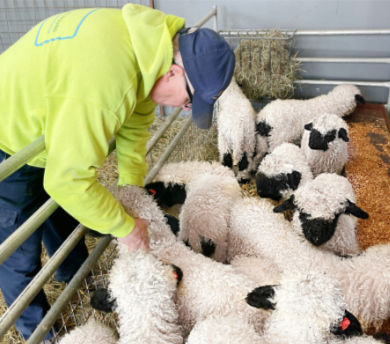
We're Cheryl and Fred Hayes. We raise fullblood Valais Blacknose sheep in Northeast Ohio, and we price every single lamb individually after it's born, healthy, and evaluated. No pre-pricing. No guessing. Here's what that process actually looks like.
Fred has spent more than 50 years raising and evaluating livestock. That's not something you can learn from a book or a YouTube video. When he looks at a young lamb, he's drawing on decades of knowing what a quality animal looks like before it fully develops, and more importantly, how to feed and manage it so it reaches its highest potential. We feel really fortunate to have that foundation behind every animal we raise.
Fullblood Valais Blacknose sheep cost $5,000 to $25,000
If you've been searching for fullblood Valais Blacknose sheep cost information, you're in the right place. Yes, that range is accurate for fullblood Valais Blacknose sheep in the United States in 2026. We know that's a lot to take in if you're new to the breed. But this isn't inflated hype. It reflects genuine supply and demand, the cost of maintaining elite genetics, and the time and care that goes into raising these animals correctly.

We were once offered $35,000 for one of our ewes. We said no. She's still here. She's the matriarch of our flock today and she consistently produces offspring of the same quality she carries. That decision tells you more about how we operate than any price list could.
A lamb at the lower end of that range is still a quality animal. A lamb at the upper end is exceptional by any measure. The difference comes down to four things, and we look at all four of them before we assign a number to any lamb born on our farm.
What We Actually Look At Before We Price a Lamb
Quality overall comes first. This isn't a vague catch-all. It's the whole picture. Does this lamb present well? Does it carry itself with the kind of presence that represents the breed? Before we ever get to specifics, we step back and look at the animal as a whole. Some lambs just have it. Some don't yet. That first impression matters.
Structure is everything for the long term. A Valais Blacknose sheep that isn't built correctly is going to have problems down the road, and those problems become your problems if you're building a breeding program. We look at bone, balance, feet and legs, and how the animal moves. A beautiful face on a poorly structured body is a pretty problem waiting to happen. We don't price structure lightly because buyers shouldn't have to learn that lesson the hard way.
Wool, especially leg wool, is one of the breed's signatures. Anyone who has spent time with Valais Blacknose sheep knows that the wool on the legs is one of the most visually striking and breed-defining characteristics. It's also one of the hardest things to breed consistently. When a lamb has dense, correct leg wool coming in early, that tells us something important about its genetics. We notice it. Buyers notice it. And it absolutely factors into price.
Markings do matter. The black markings on a Valais Blacknose, the face, ears, knees, and hocks, should be distinct and correct. Not every lamb hits the breed standard perfectly, and that's just the reality of working with genetics. But when a lamb comes out with clean, well-defined markings in all the right places, that's a lamb that will turn heads in any pasture.
Ewe, Ram, or Wether: Does the Sex Affect the Price?
It can, but not in a simple formula. A ewe with exceptional structure, wool, and markings has significant value as a breeding animal. A ram with the same qualities has the potential to influence an entire program for years. A wether won't contribute to a breeding program, but for someone who wants a companion animal or a fiber animal, a wether can be a wonderful option at a price point that reflects that purpose.
What we won't do is discount a quality animal simply because of sex, and we won't inflate a mediocre animal because demand is high. The price reflects the lamb in front of us, not the market pressure around us.
Why We Don't Price Until After They're Born
We get asked about this a lot. People want to get on a list, lock in a price, and know what they're getting before lambing season. We completely understand that impulse. But we've made a commitment to our buyers that we think is worth more than the convenience of pre-pricing.
Every lamb is different. Every birth has variables we can't predict. We've had lambs that looked outstanding on paper by genetics alone that were average when they arrived, and we've had pleasant surprises that exceeded every expectation. Pre-pricing before we can evaluate would mean we're selling you a number, not an animal. That's not how we want to do business.
When you buy a lamb from Lovers Lane, you're getting a price that reflects that specific animal after we've had time to observe it, evaluate it honestly, and stand behind what we're telling you.
A Note on Fullblood vs. Purebred
You may see both terms used across Valais Blacknose farms in the US, sometimes interchangeably. They are not the same thing, and the distinction matters when you're spending this kind of money.
Fullblood refers to animals whose genetics trace back entirely to imported Valais Blacknose semen or embryos, with no breed-up percentage in their lineage. This is the standard we work to at Lovers Lane. We raise fullblood Valais Blacknose sheep, and we're transparent about every animal's genetic background.
If you're comparing prices across farms, make sure you're comparing the same thing. A lower price may reflect a lower percentage animal, which is a legitimate choice for some buyers, just not the same product.
What to Look For No Matter Where You Buy
We want you to end up with a great animal. Even if that animal doesn't come from us. So here are a few honest things to look for when you're evaluating any Valais Blacknose sheep or any farm selling them.
Ask about the genetics and get documentation. A fullblood Valais Blacknose should have a paper trail. Registered animals with documented lineage aren't just a formality. They're your protection as a buyer and your foundation as a breeder. If a seller can't or won't provide that, keep moving.
Look at the whole animal, not just the face. The face is what draws people to this breed. We get it. They're stunning. But a beautiful face doesn't tell you anything about bone structure, feet, leg wool, or how that animal will hold up over time. Take your time. Ask questions. Request photos and video from multiple angles.
Understand what you're buying it for. A companion wether has different requirements than a breeding ewe. A ewe you're adding to a serious program has different requirements than one you're keeping as a single farm pet. Know your goal before you start shopping so you're evaluating animals against the right standard.
Ask how the lambs are raised and managed. This will tell you a lot about how a farm operates.
Don't let price alone drive the decision.
The cheapest Valais Blacknose isn't a deal
if it isn't what it's represented to be.
And the most expensive one isn't automatically the best. Price should reflect quality. Your job as a buyer is to understand enough to know whether it does.
We share this not to complicate your search but to help you feel confident in it. An educated buyer ends up with an animal they're proud of, and that's good for everyone who loves this breed.
What This Means for You as a Buyer
If you're early in your research, we hope this gives you a realistic foundation for what to expect. If you're further along and ready to ask specific questions about what we have available, we'd love to hear from you.
We're a small operation on purpose. We know our animals individually. We don't sell lambs we wouldn't be proud of, and we don't price them based on what we think we can get away with. We price them based on what they're actually worth, and we're happy to walk you through why.
If you're looking for fullblood Valais Blacknose sheep in Northeast Ohio or anywhere in the US, take a look at what we currently have available. And if you have questions we haven't answered here, reach out. We're real people and we actually respond.


Comments